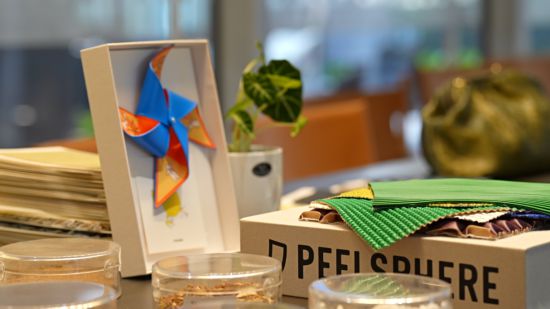
(The application proportion of sustainable materials such as RPET and plant-based leather in luggage manufacturing continues to rise)
Piñatex®: Commercial Breakthrough of Pineapple Leaf Fiber
Piñatex® (pineapple leaf leather), developed by Ananas Anam, is currently one of the most commercially mature plant-based leather materials. The material uses fibers extracted from discarded pineapple leaves on Philippine farms, converting 27 million tons of pineapple leaf waste into textile-grade materials annually without requiring additional land, water resources, or pesticide use.
The Performance version of Piñatex® already possesses quite excellent physical properties: tensile strength of 520N, tear strength of 226N, Martindale abrasion resistance of 300,000 cycles, flex resistance of 150,000 cycles, and elastic recovery rate of 94.8%–99%. In terms of carbon emissions, Piñatex® generates 2.69kg CO₂ per square meter, a reduction of 44% and 90% compared to PU leathers 4.81kg and animal leathers 27.30kg, respectively.
Currently, brands such as Nike and Hugo Boss have begun using this material. For luggage OEM enterprises, mastering the cutting, sewing, and finishing processes of pineapple leaf leather will become a key capability for taking on high-end eco-friendly orders.
MIRUM®: A Milestone in Zero-Plastic Plant Leather
MIRUM® material, launched by US-based Natural Fiber Welding, is the worlds first 100% plastic-free vegan leather suitable for large-scale luggage production. The material uses natural rubber, vegetable oils, and plant waxes as binders, with fillers including cork powder, coconut shell fiber, rice husk, and clay minerals, and a backing of GOTS-certified organic cotton or Ecovero Tencel.
MIRUM®s carbon footprint is only 0.84–2.1kg CO₂e per square meter — 1/14 that of chrome-tanned leather and over 1/7.5 that of PU/PVC synthetic leather. The product has obtained USDA BioPreferred 100% biobased certification and is free of PFAS, phthalates, and heavy metals. More importantly, after the product reaches end-of-life, it can be reprocessed into new materials or naturally decompose into harmless elements, achieving zero microplastic pollution.
NFW has raised over US$150 million to expand production capacity, meaning that large-scale application of zero-plastic leather is moving from vision to reality.
Mylo™: High-End Exploration of Mycelium Leather
Bolt Threads Mylo™ mushroom leather uses fungal mycelium (the root network of mushrooms) grown on agricultural waste such as corn stalks. Growth takes only 4–9 days, and with drying and finishing, the entire production cycle is about 2–3 weeks — whereas animal leather production requires years of livestock farming plus 6–8 weeks of chemical tanning.
Stella McCartney was the first major fashion brand to use Mylo™ material, and the Council of Fashion Designers of America (CFDA) has included it on its top designer materials list. Although currently more expensive and mainly applied to high-end product lines, as technology matures and production capacity expands, mycelium leather is expected to enter the broader luggage market in the coming years.
Implications for Luggage Manufacturing Enterprises
Material innovation is reshaping the competitive landscape of the luggage manufacturing industry. For OEM enterprises, positioning is needed in three areas:
First, building new material process capabilities — proactively R&D processing techniques for plant-based leather and recycled fabrics to form technical barriers;
Second, building a sustainable supply chain system — practicing circular economy concepts across the entire chain from raw material procurement to manufacturing to product recycling;
Third, proactively addressing the ESG needs of brand clients — converting sustainability capabilities into market competitiveness and securing higher value-added orders.
Industry experts point out that the next 3–5 years will be a critical window for the popularization of plant-based materials in the luggage industry. Enterprises that are the first to complete technology positioning and capacity building will occupy an advantageous position in the global sustainable consumption wave.
Information Sources:
-
SUNTEAM: "Top Vegan Leather Alternatives For 2026 Bags" (2025-12-19)
-
CCTV News: "Coffee Grounds and Pineapple Leaves Made into Luggage Sold to the World — Multiple New Tracks Debut at Canton Fair" (2024-11-03)
-
Peoples Daily Online Shenzhen: "Waste Materials × Top Brands, Bright Aesthetics Going Global" Supporting Images (2026-01-15)